The question
Detecting machine-written text matters for education and publishing. I tested whether features such as perplexity, burstiness and lexical diversity are enough on their own.
What I did
Cleaned 1,000 labelled samples (463 marked AI, 537 marked human) and engineered text statistics.
Compared each feature between AI and human text with t-tests.
Trained logistic regression, random forest, gradient boosting and SVM models.
Checked results with confusion matrices, ROC curves and a PCA projection.
What I found
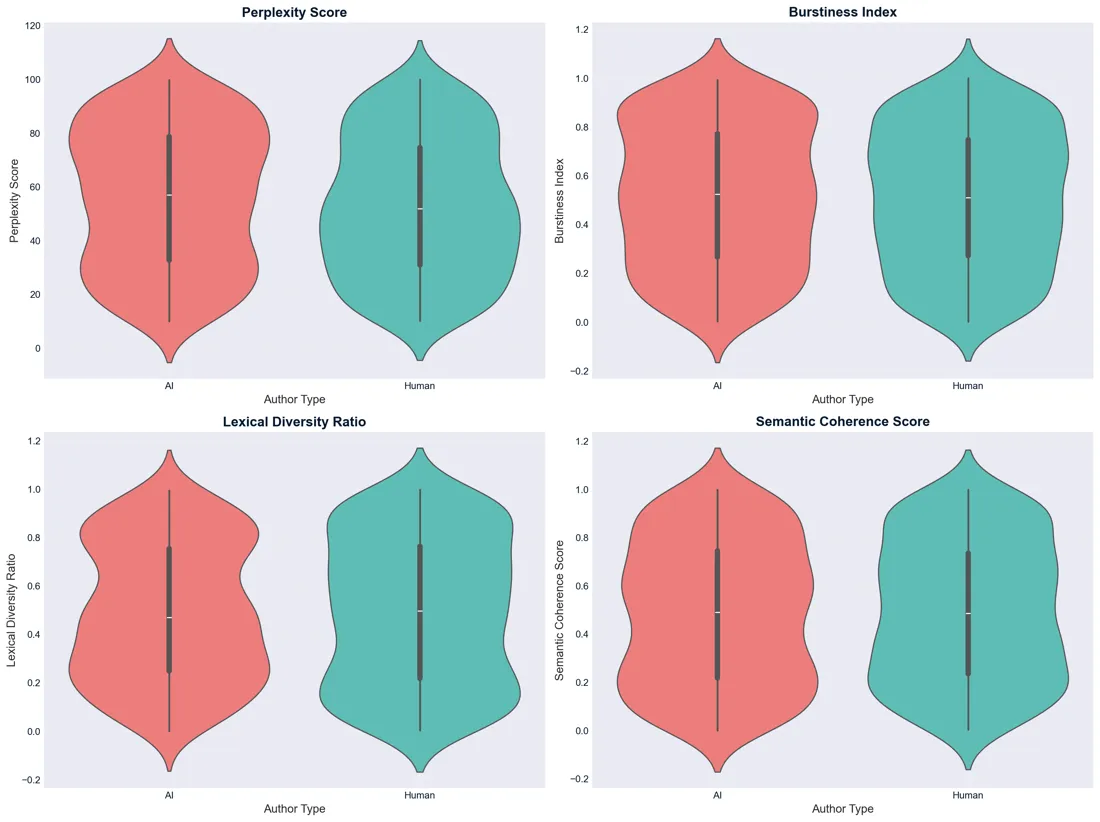
Only perplexity differed significantly between the groups (AI 56.1 against human 52.8, p = 0.043). Burstiness, coherence and diversity did not.
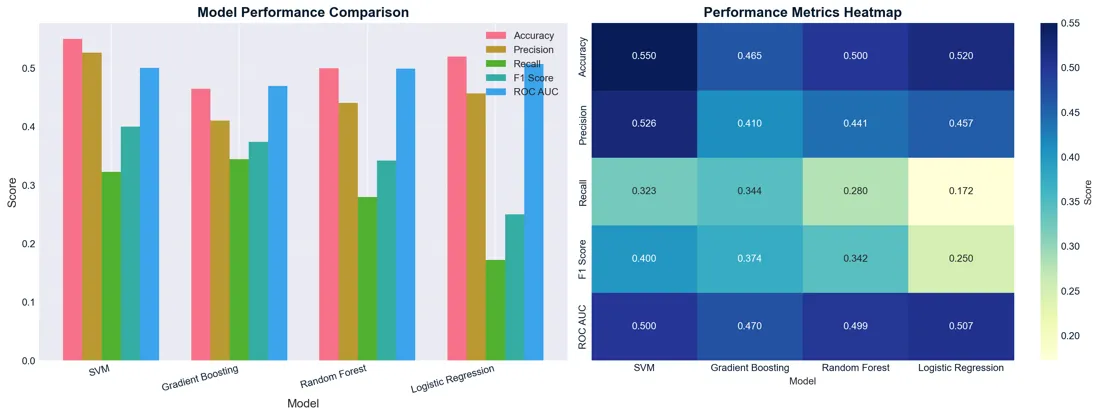
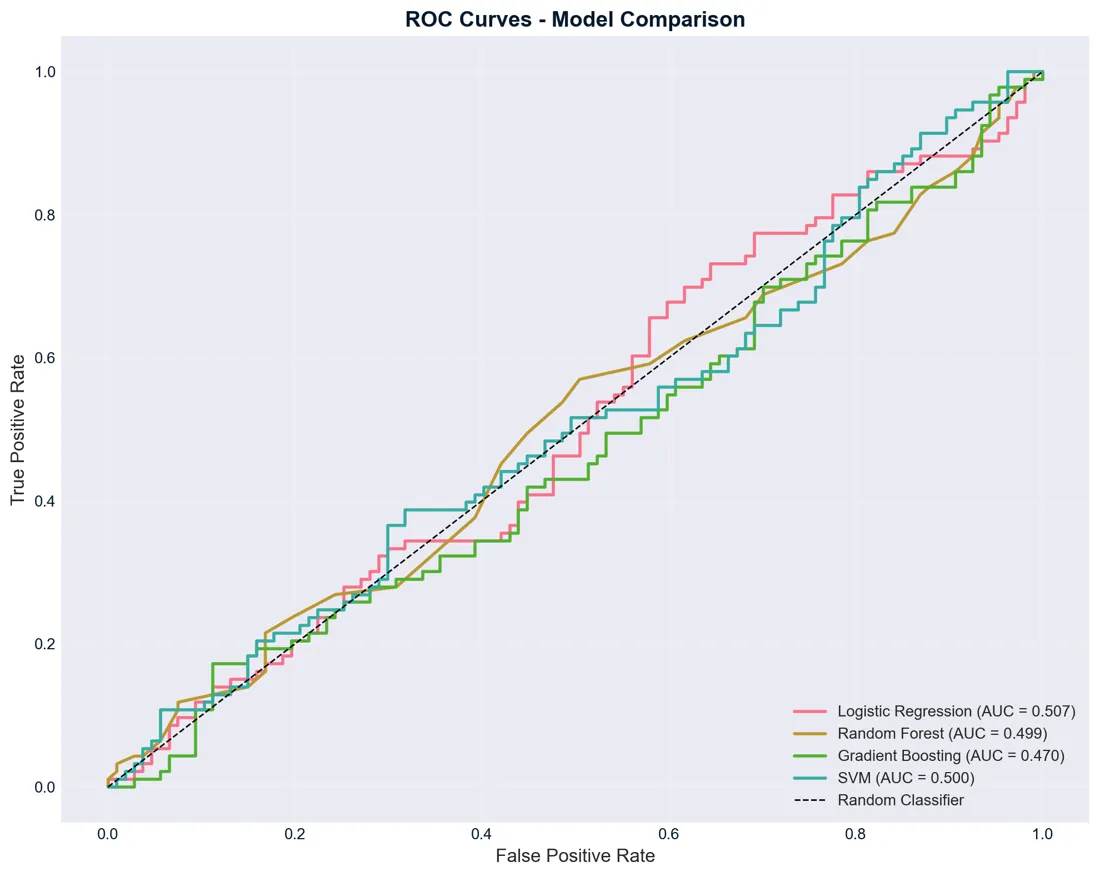
The best model, an SVM, reached 55% accuracy with a ROC AUC near 0.50, which is chance level.
It caught only 32% of AI texts. The curves in the ROC plot sit on the diagonal for every model.
Charts from the analysis
Limits to keep in mind
About the data
This is a negative result and I report it as one. With 1,000 samples and only summary features, there is little signal to learn. Working from the raw text would be the next step.